The first French movie made after the Second World War was the documentary-style La Bataille du Rail, a celebration of the railway workers’ activities in sabotaging German trains during the last days of the Occupation, and it gave the somewhat misleading impression that the whole nation was involved in the Resistance.
Some years passed before the French cinema came seriously to grips with the experience. The results were often sombre, complex movies about collaboration and betrayal like The Army in the Shadows (directed by Jean-Pierre Melville, who’d been in the Resistance and fought with the Free French Army), Marcel Ophuls’s The Sorrow and the Pity and Louis Malle’s Lacombe Lucien. Later, in 1995, there was Jacques Audiard’s satirical Un Héros très discret (aka A Self-Made Hero) about a nonentity who takes advantage of postwar confusion to pass himself off as a Resistance hero.

In Britain during the postwar years there was a spate of factual movies about the courage of British-trained agents operating with the Maquis, among them Ealing’s Against the Wind, Anna Neagle in Odette and Virginia McKenna as Violette Szabo in Carve Her Name With Pride. More recently, there have been several TV documentaries on the relationship of our Special Operations Executive and the French Resistance, taking a highly critical view of the way things worked without denigrating the heroism of the men and women dropped into France.
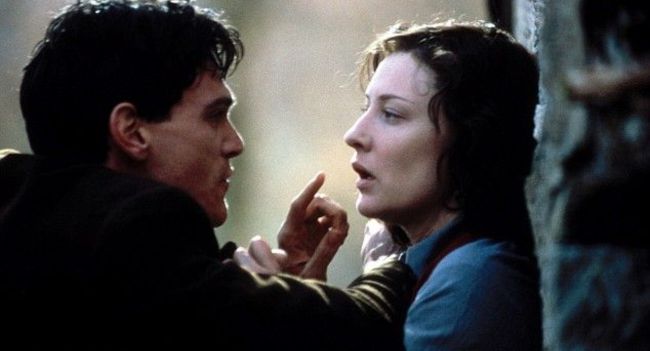
The disappointing movie based on Sebastian Faulks’s novel Charlotte Gray has a light garnishing of the revisionist spirit, but is, otherwise, a curious throwback to those postwar pictures, though lacking their monochrome realism.

Directed by Gillian Armstrong (whose Australian compatriot Fred Schepisi made his European debut with Plenty, a more serious picture about a woman shaped by her experience as an agent in wartime France), it’s about the recruitment of Charlotte (Cate Blanchett), a young Scottish woman, in 1943, her training, and her service in Vichy France.
It starts with an unlikely conversation on a British train in which she’s hooked by an intelligence officer, and moves from one implausible scene to another. In the clunking dialogue written by Jeremy Brock (co-creator of TV’s Casualty), questions of life, love, the war, and the conflict between Gaullists and communists are briefly discussed but not dramatised.
In London, Charlotte has an affair with an RAF pilot who’s shot down over France. This provides the trivial motivation for her wanting to be dropped into enemy territory and the search for him jeopardises her comrades. In France, she’s drawn to a dedicated Resistance leader, Julien (Billy Crudup) and, in fact, she doesn’t have much to do in the espionage line, so she’s assigned to mothering two little Jewish boys being sheltered by Julien’s elderly father (Michael Gambon) in his dilapidated country house.
Charlotte never appears to be in real danger the way Odette Churchill and Violette Szabo were, and the movie is soft and romantic when it should be hard and ruthless. This makes offensive its use for sentimental, melodramatic effects of a train of cattle trucks taking Jewish prisoners to the death camps.
The desaturated colour (a borrowing from French films dealing with this period) is an attempt to give the picture an air of reality, and trouble has been taken over the costumes. But the authenticity is undermined by the decision to dispense with subtitles and have the French characters speak English with a slight accent. Whether speaking real English or English-as-French, Blanchett uses a soft Scottish burr; the stroppy agent played by Ron Cook speaks with a strong Birmingham accent throughout, while Michael Gambon, looking like a cross between Gordon Kaye in ‘ Allo ‘Allo and the tramp in Pinter’s The Caretaker, talks like an upper-class Englishman who’s picked up a touch of a local accent after some years as a tax-exile in France.
The Germans, however, are allowed to speak their native tongue. At the end, as the camera sweeps over fields of fragrant French lavender, you can only cry, Odette, where is thy sting?
SOURCE: THE GUARDIAN