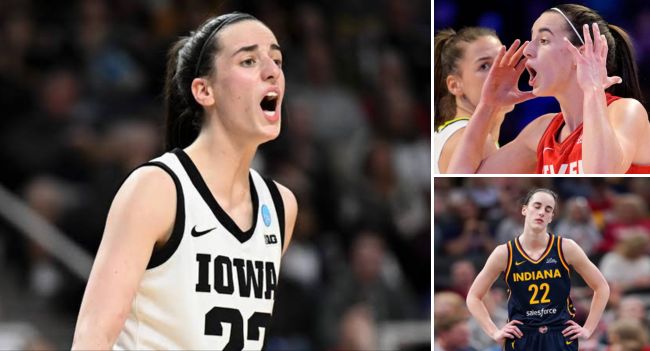
The Corporate Sabotage of the Caitlin Clark Effect
The distance between sports executive luxury suites and the harsh reality of economic survival has never been wider than it is inside the modern women’s basketball ecosystem. For the past two years, an exhausting corporate apparatus has worked overtime to minimize the most revolutionary commercial force the sport has ever seen. The persistent attempt to suppress the cultural and economic reality of the Caitlin Clark phenomenon is no longer just bad basketball analysis. It has graduated into institutional malpractice.
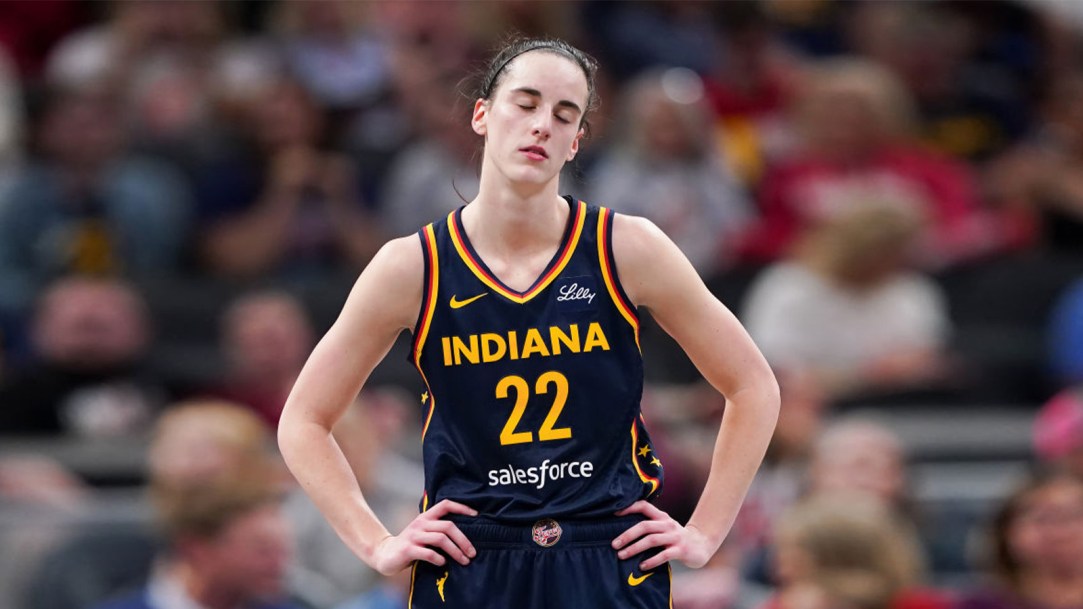
We are witnessing a bizarre, highly synchronized gatekeeping campaign managed by league executives, media tastemakers, and an old guard that seems completely terrified of acknowledging who actually keeps the lights on. The latest annual WNBA general manager survey serves as the ultimate case study in this professional delusion. When front-office decision-makers were asked the definitive foundational question of sports team construction—which player they would choose if they were starting a franchise today—the answers exposed a stunning level of collective incompetence.
The General Manager Disconnect
The voting breakdown of that franchise-builder question looks less like an objective executive assessment and more like a emotional support group for threatened egos. Paige Bueckers of the Dallas Wings walked away with thirty-three percent of the vote, leaving the transcendent economic anchor of the league, Caitlin Clark, tied for second with A’ja Wilson at a mere twenty percent.
“All those GMs probably going to get fired because this is a money business and the money is about Caitlin Clark.” — Lisa Leslie

WNBA legend Lisa Leslie cutting through the administrative fog is the dose of common sense this environment desperately required. Professional sports franchises are not hypothetical art projects. They are high-stakes businesses operating in an incredibly cutthroat entertainment economy. To build a franchise means to maximize revenue, secure massive media investments, sell corporate sponsorships, and guarantee that seats are occupied. Choosing anyone other than the single player who single-handedly forced multiple teams to abandon their standard venues for massive NBA-sized arenas is an act of spectacular self-sabotage.
The corporate justification for this slight centers around Clark missing significant time in her second year due to groin and quad injuries. The critics pounced on that physical setback, desperate to frame her rookie season as an isolated flash in the pan. They sprinted to the microphone to crown other players as more marketable, more adaptable, and more structurally sound. Yet, the moment Clark returned to the floor, she immediately delivered twenty points and seven assists in her very first outing. The attempt to rewrite the hierarchy based on an injury history while ignoring the massive financial reality she commands is pure hypocrisy.
Shifting Metrics and Broadcast Illusions
The consequences of this administrative hostility are starting to show up where it hurts the most: the actual balance sheets. While the league office relies on carefully spun headline numbers to paint a picture of endless upward trajectory, the underlying data tells a much more alarming story.

Consider the heavily promoted television broadcast numbers from the early stretch of the schedule. The league celebrated an average broadcast audience of just under two and a half million viewers for a high-profile matchup between the Indiana Fever and the Dallas Wings. Corporate press releases immediately hailed it as a massive historical milestone for the network. What they intentionally omitted from the conversation was the reality of the previous season’s metrics.
The prior season opener between the Fever and the Chicago Sky drew an average of two point seven million viewers. A straightforward mathematical comparison reveals a drop-off of two hundred thousand viewers on the surface, but the true decline is masked by a quiet alteration in how these media platforms calculate their audience size.
| Measurement Era | Data Collection Methodology | Estimated Impact on Final Metrics |
| Traditional Framework | Legacy network sampling extrapolating data across small household pools | Conservative baseline standardizing historical television engagement |
| Modern Big Data Integration | Automated tracking incorporating smart televisions and active mobile streaming devices | Artificially inflates visible viewership metrics by up to ten percent |
When evaluating these figures on a true comparative basis, this season’s opening broadcast was actually viewed by an audience closer to two point two or two point three million people. This represents an actual loss of nearly half a million consistent viewers. For a sports league trying to cement its status as a premier media property, losing an audience equivalent to an entire major metropolitan area for the highly anticipated return of your biggest draw is a massive structural failure.
Voting with Wallets in Empty Arenas
This viewer fatigue is not a random coincidence. It is the direct result of casual sports consumers realizing that the league’s institution treats its marquee star like an unwanted guest. When fans watch an ecosystem routinely diminish its primary asset, they do not stick around to sample the rest of the product. They simply change the channel and take their capital elsewhere.
The evidence is mounting across physical ticket offices as well. In the weeks leading up to the regular season, the Indiana Fever social media accounts were actively posting direct ticket purchase links, essentially begging the public to fill seats for their home opener. During the height of the initial wave of popularity, a fan could not get anywhere near a primary ticket market platform without encountering immediate sellouts. Now, franchises are forced to actively hustle online to avoid visible patches of empty seats.
The problem is even more glaring for the entities that are supposed to pick up the slack. When Paige Bueckers and the Dallas Wings faced off against the Minnesota Lynx—featuring Olivia Miles, the clear frontrunner for Rookie of the Year—the arena failed to sell out its modest seven thousand seat capacity. Less than six thousand fans bothered to show up to watch the precise alternative stars that general managers claim they want to build franchises around. The gatekeepers want the prestige of a thriving league without honoring the specific player who generates the revenue required to sustain it.
Institutional Gatekeeping and the Olympic Precedent
This pattern of self-defeating behavior did not materialize overnight. The template was established during the international basketball cycle when USA Basketball chose to omit Clark from the Olympic roster. The decision-makers hid behind institutional jargon, claiming that roster spots had to be earned through traditional political longevity rather than current on-court production and global cultural relevance.
They opted instead to give a legacy roster spot to Diana Taurasi to secure a sixth gold medal. While honoring past greatness has its place in museum exhibits, utilizing a premier global marketing platform to showcase an aging veteran at the absolute expense of the sport’s greatest economic accelerator was an unparalleled disaster. Lisa Leslie openly noted that she could not comprehend how the contingent left the country without its definitive game-changer.
The institutional justification becomes even more hypocritical when looking at the cold basketball metrics. At the time of the roster construction, Clark was outperforming three-quarters of the players selected for that team in points, rebounds, assists, and steals. She did not just deserve to be on the flight for the marketing optics; she commanded the spot based on absolute statistical dominance. The decision to exclude her was a glaring example of an entrenched establishment choosing to protect its internal hierarchy over expanding the sport’s global footprint.
The On-Court Reality vs. The Narrow Narrative
The critics who dominate the media landscape love to isolate Clark’s long-range shooting percentage as proof that she is overhyped. They desperately want to paint her as an erratic volume shooter whose style cannot translate into sustained professional success. They treat her like a one-dimensional highlight reel rather than the elite floor general she actually is.
This narrow focus completely ignores the underlying engine of her game. Opposing coaches are fully aware that her three-point shot is merely the outer layer of a much more dangerous offensive package. The moment the basketball crosses the half-court line, she forces defensive schemes to stretch to uncomfortable boundaries. This deep gravity opens up the entire floor, allowing her to exploit passing lanes that other guards cannot even see.
Her true value is found in her elite basketball intelligence and her peerless distribution skills. It is often conveniently forgotten that she shattered the all-time single-season assist record as a rookie. Professional coaches do not have the luxury of participating in internet hate campaigns; they have to design schemes to survive her. The leadership, the vision, and the command of pace are what make her a generational talent. The logo three-pointers are just the marketing hook that gets people into the building.
The Path Forward
The corporate establishment of the WNBA is playing a highly dangerous game of chicken with its own consumer base. They are operating under the deeply flawed assumption that the current wave of public attention is a permanent fixture that will remain intact regardless of how they treat the individual who created it.
History shows that casual sports fans are entirely conditional. They do not possess an innate loyalty to league branding or institutional history. They engage with exceptional individuals who capture their imagination and disrupt the status quo. If the league, the team executives, and the legacy media continue to work in unison to relegate Caitlin Clark to the status of an ordinary player, the audience will continue to exit the arena. Once a sport breaks the trust of a newly acquired audience, convincing those consumers to return is a near-impossible task. The gatekeepers need to stop fighting their own success before they completely finish dismantling the house they spent three decades trying to build.
Source: https://news.xwrapper.com/tuananhrb/wnba-legend-goes-off-on-wnba-gms-for-disrespecting-caitlin-clark-at-the-perfect-time/