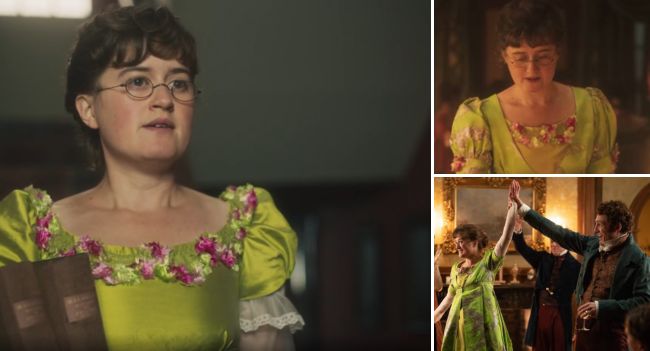
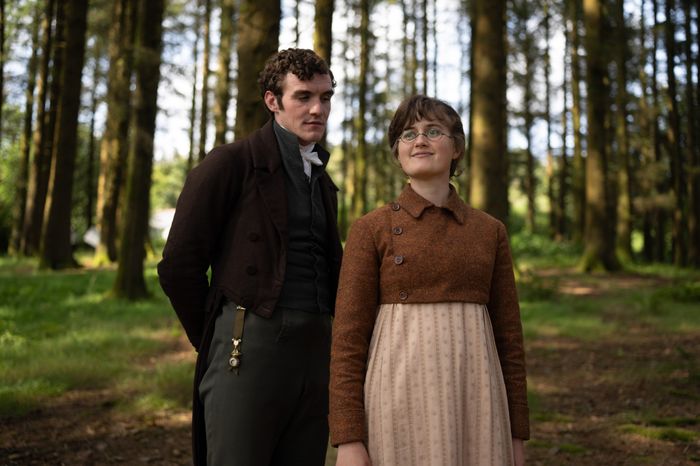
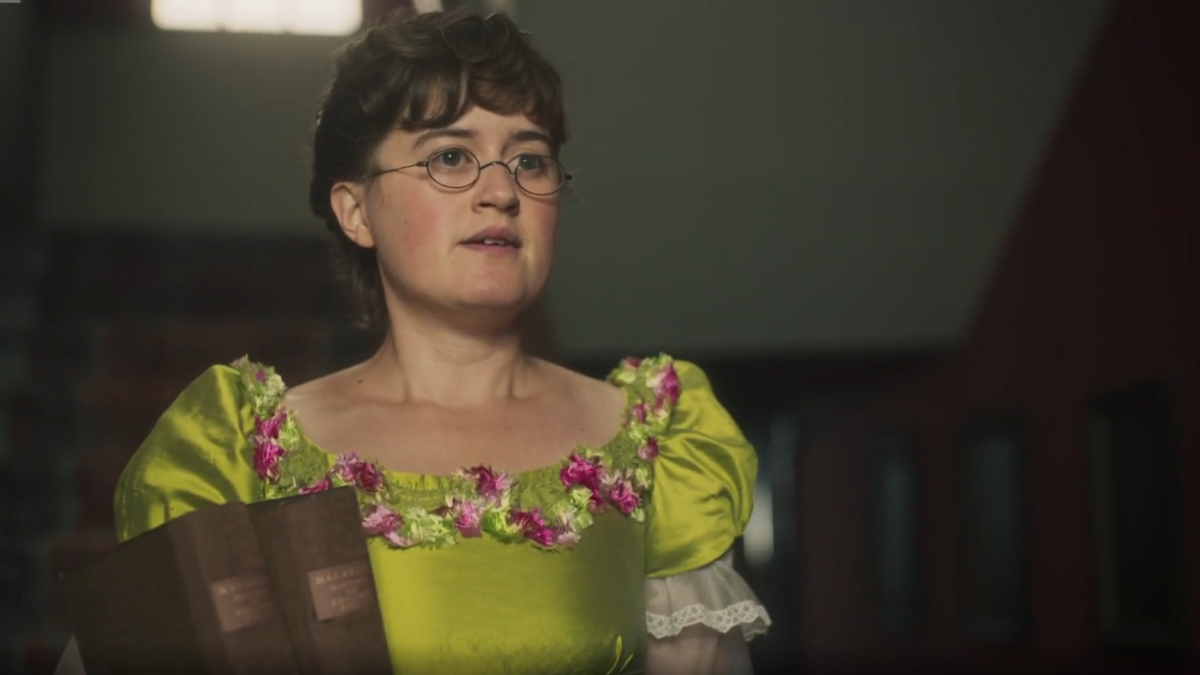
The Other Bennet Sister spends a lot of its running time poking fun at the hallowed genre of the British period drama. Based on Janice Hadlow’s novel and adapted by Sarah Quintrell, the charming BBC One/BritBox series adjusts the perspective of Jane Austen’s Pride and Prejudice around the Bennet family’s often-overlooked middle daughter, Mary, who’s presented in the novel as uptight and a bit priggish. Played by Ella Bruccoleri, the show’s Mary is recontextualized as a sweet, nerdy girl out of step with her time and beaten down by her mother’s assertions that her looks and personality will exclude her from a successful match. In The Other Bennet Sister’s version of Regency England, not one but two suitors end up emerging from a lake in clingy wet shirts, though the heroine is not as effortlessly winsome as the subjects of other Austen adaptations tend to be. In Bruccoleri’s favorite homage to the 1995 Pride and Prejudice miniseries, Mary wistfully gazes at herself in a mirror, then goes to blow out her candle — only in this instance, she can’t manage to extinguish it. “There Jennifer Ehle looks so graceful and beautiful,” Bruccoleri says with a laugh, “but here Mary goes to blow out the candle and it just doesn’t go out.”
Despite her lack of charm and poise, Mary moves to London to work as a governess and catches the eye of the dashing but callow Mr. Ryder (Laurie Davidson) and the sweet, dutiful, poetry-loving Mr. Hayward (Dónal Finn). Viewers familiar with the period drama’s tropes know sensitive Hayward’s the obvious choice, but he and Mary must work through a few impediments first: He’s promised to another woman, while Mr. Ryder proposes Mary live a threadbare, adventurous life with him as his mistress, which Mary, of course, rejects. The penultimate episode thrusts Mary, Ryder, and Hayward together on a stormy hiking trip in the Lake District, where Mr. Hayward’s demeanor changes after Mr. Ryder pulls him aside to discuss an important matter. In the finale, we learn the circumstances behind that change of heart: Ryder came into an inheritance and asked Hayward for his blessing to marry Mary. But she declines Ryder a second time, vowing to make her own path alone in life and expressing disappointment that he and Hayward conspired behind her back. Soon after, she extricates herself from her mother for the final time after Mrs. Bennet expresses her horror at Mary turning down a proposal of marriage.
Once Mary’s back in London and content on her own, however, Mr. Hayward returns a final time to confess his love. Though Mary admits her disappointment in him, she ultimately accepts his proposal. “It was always important to us that she reached a place of proper contentment before Mr. Hayward comes back into her life,” says Bruccoleri. “She has to genuinely be happy and be fine by herself, not just be waiting for him to return.” Though the series ends on the appropriate Austen happily ever after, Mary, Hayward, and the other Bennets will return for a just-announced Christmas special at the end of the year. “Sarah’s still writing the scripts and it’s being molded as we speak, but I went on a trip to Austin with her and talked to her about the story lines then,” says Bruccoleri. “I felt really excited by the ideas she put across to me, because I was always reticent about doing more of this — there had to be a reason.”

After playing Mary Bennet, how many geology facts do you have bouncing around your head now?
I did read James Hutton’s Theory of the Earth actually. I feel like I’m humble bragging when I say this, but I tried to read all the books Mary reads, which is an insanely ambitious task, and was stupid because I was also trying to film a TV show. But Theory of the Earth is just about different types of rocks. I did not retain much information because it’s so dry — quite literally dry, as you’d imagine. Like, about different types of sediment.
Tell me about filming the scene with Dónal Finn, where Mr. Hayward comes back to Mary and proposes to her in the park. It’s a big romantic moment and a scene where Mary has to unpack a lot of the hurt feelings she’s had about Hayward keeping secrets behind her back and not directly expressing himself. She even punches him before they embrace.
It’s quite a nerve-racking experience filming anything that’s signposted as the romantic climax. There’s a lot riding on that moment. You can easily get into your head about it. The show’s writer Sarah Quintrell was on set most days, and she kept saying to us, “This is not the romantic climax of the show. This is just one moment in these people’s lives and they’ll have other moments where it’s dramatic and it’s a turning point. This is just one of them.” Once we’d done the moment where we embraced, we were both so relieved that those moments afterward, where they’re just giggling in each other’s arms, were real to how we actually felt. We’d achieved this thing, and then we genuinely couldn’t stop laughing.
How did you approach recording the voice-over from Mary at the end, which is revealed to be a part of an “advice to young women” book she is writing? She tells the audience that she married Mr. Hayward in her own time but that, “I hope you’ll realize that is almost beside the point.” The real point is that she needed to get outside her own family and see the world to find her own place in it.
The recording of the voice-over was in a sense more of a labored experience than the filming. I must have done about five or six sessions on it, because everyone was all so particular about what it needed to be. We were thinking, Which version of Mary is this? Who is she speaking to at what point in her journey? There is less and less of it as the series goes on, because the idea was to be as sparing with it as possible.
Who did you decide she was speaking to?
There’s a young woman, Felicity, you see snippets of when Mary has chosen this life as a governess and Mary is teaching her in a few brief moments. We felt that the voice-over is Mary speaking to that young woman, relaying her own difficulties growing up in Regency England.
So much of the show is Mary coming to terms with her own difficult relationship with her mother. It makes sense that she’s trying to heal and help the next generation.
That was huge, because Mary has had the realization that what was supposed to be a nurturing maternal force in her life had a damaging impact on her. If you’re caring for someone, as a parent or teacher, you have the power to change their life for better or for worse. Mary arrives at a place of understanding that, by the end of the series, she would be reticent to make the same mistakes with someone else.
Before Mr. Hayward comes back, Mary has what feels like a decisive fight with her mother, who cannot believe that she has turned down Mr. Ryder’s proposal. It’s a moment where you can see Mary come into her own and insist on her own needs, even as it’s painful to cut her mother out of her life. What was it like to film it with Ruth Jones?
Ruth is a very sensitive person in real life and she was saying things that were quite cruel and barbaric at times as well as personal about the way that I look. Obviously, she’s talking about Mary, but I’m an actor and she’s talking about my ruddy complexion, and I think she was terrified it was going to affect me in real life. She was really conscious and sensitive the whole time. It’s such a complicated relationship between them, and it’s what the whole series hangs on. By episode ten, we really explored with sensitivity and understanding the difficulty in separating yourself from a toxic familial relationship. It’s not an easy decision to say, “Actually, I’m done with this now.” That was one of my favorite days on set because we got loads of time to film it. We had three quarters of a day to film that scene and we got to rehearse it like we were filming a play in the living room.
An aspect of the show I appreciated was the way it opens up the character of Mr. Collins, who can be read as a buffoon. Here, he comes across as beaten down by societal expectations, too.
The scene they share in the library is maybe my favorite in the whole series, because it’s these two people trying to be quite vulnerable with each other and admitting to each other that they’re both unhappy in the lives they’ve chosen, and yet they can’t say that overtly. They’re trying to intellectualize it, being like, “Well, if we sat down and studied the science of happiness, maybe that would be an interesting task.” What they can’t say is that it’s because they’re depressed. In that moment, those two characters are clinically depressed, really, and unable to share in it together because there’s always other people around.
It’s also fun to see a traditional Austen character explore the world of romantic poets. As an English major, I appreciated watching her move between one intellectual tradition and another.
And one that Mary’s spurned in the past because she thinks it’s not intellectual enough. Though I think that’s her self-defense, because she’s afraid of feeling things. I would actually carry around my own little copy of Lyrical Ballads [a collection of poems by Coleridge and Wordsworth published in 1798] and sit by a lake or in the hills and read the poetry.
Tell me about taking Mary to the Lake District, which you shot in a beautiful-looking part of Wales, for the penultimate episode of the season.
It was a wonderful part of her liberation, I suppose, from several things in her life. She sits in her body more and feels freer and stands taller. We had such a nice time filming that, and I got to experience that feeling where you’re looking off from a summit and your shoulders drop. It was a perfect parallel journey with the one she goes on internally.
And, ultimately, she gets to live in London while so many other Austen characters stay in the countryside. What did you think of the life she found herself in?
Being in the city unlocks a lot for her. A lot of people have experienced this, where you come from a small town and your bubble of existence is so tiny and then your worldview is really expanded. That happened to me. I left home when I was 18 and moved to the city. Suddenly you’re able to find your people and discover who you are.
A fun layer of the show is that it’s doing both a classic British period drama and sending up the tropes of the genre — like the scene where both Mr. Hayward and Mr. Ryder fall in the lake, a double Darcy wet-shirt experience. The Other Bennet Sister was also produced by people who have made a lot of period dramas. How’d you experience that self-awareness on set?
It’s such a rich institution, the British period drama. It was fun to take those moments and poke fun and pay homage to them. Our show was made by people who grew up on the 1995 Pride and Prejudice and it really informed the way they make art.
Do you have a favorite wink at that series in this one?
There’s a scripted scene where Mary goes to blow out a candle before she goes to bed. It’s classic. She’s looking at a mirror and she’s in a Regency nightgown. When we were doing it, Jennifer Sheridan, the director, was like, “I want you to mirror the shot in the ’95 adaptation of Jennifer Ehle looking at herself in the mirror, but let’s make it Mary.” There, Jennifer looks so graceful and beautiful, but here Mary goes to blow out the candle and it just doesn’t go out.
Do you remember when you first watched that Pride and Prejudice?
I only watched it before filming the show. I watched a fair amount of period drama growing up, but my access to Pride and Prejudice, including the adaptations, has only opened up as a result of doing this. I was cast two months before filming and just went into a complete hole of watching everything. I knew of it, and I’d seen all the iconic bits of it, but I was late to the party!
The show has really blown up on social media as it aired. I’m seeing Mary Bennet edits set to Olivia Rodrigo songs when I open TikTok. What’s been your experience of watching that excitement build around the character?
I’m not actively seeking it out, but people tag me, and I honestly haven’t gotten my head around it. I haven’t processed that it’s happening to me. But the reaction has been beautiful. I always set the bar low when I do things, like, Probably no one will watch this. I believe in it but I have to be ready to accept that. For me, it’s not the quantity of response but the quality of the reaction. It’s lovely that people really feel seen by the character. They come up to me and say it’s rare to see a lead in a female period drama role who doesn’t look like a supermodel and isn’t glammed up. We’ve gone with a simple, wholesome story and people have taken it to heart. I’m proud of that.

It was just announced Mary Bennet is coming back for a Christmas special. Have you talked with the creative team about what it’ll contain?
I have a little bit. There’s a lot more of those conversations to be had, because it’s all happening quickly. It’s gotta come out at Christmas, so that’s not much time! But we’re going to film it over a short period of time this summer.
You talked about the prep to get into the mind-set of Mary before filming the series. Is there a way in which you plan to get back into Mary mode, to reacclimate for the Christmas special?
I haven’t gotten my head fully ready yet. I had made a Mary playlist that I would add to as I went along filming, so I’ll probably use that to remind myself where Mary was. I don’t want to give too much away about the story, but if we have advanced her journey, then I need to also work out where she is now. And then just always more reading with Mary. I’ll comb over those old scripts and my notes and notebooks and try to use that to inform where she is now in her life.
What was on the Mary playlist?
A lot of John Cale. Aldous Harding. Big Thief. A lot of it was American, I guess, but that kind of slow, miserable yearning stuff, like the Smiths —though I don’t think there was any Smiths in there. But it’s a good playlist! I pride myself on it.