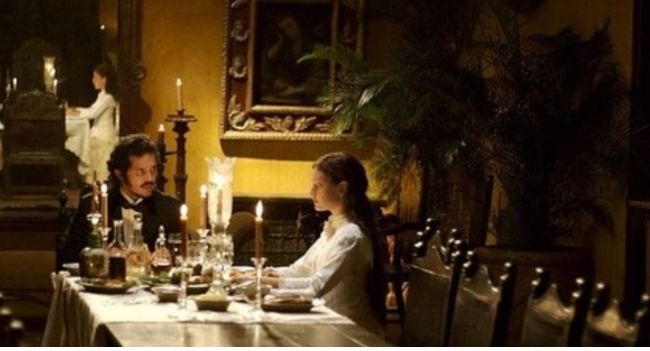
Bardem lusts through Marquez adaptation
Simply awful adaptation of the Gabriel Garcia Marquez novel gets points only for its unintentional humor; otherwise, Mike Newell’s Love in the Time of Cholera is a chore to sit through and an insult to most.
Florentino Ariza (Javier Bardem) falls in love with Fermina (Giovanna Mezzogiorno), has his heart broken, and devotes his life to sleeping with as many women as possible in order to heal the pain. No, really – that’s the plot.
There’s a lot of nudity along the way, which helps, but we basically sit through meaningless tryst after meaningless tryst as a depressed Florentino slogs through life.

Yet somehow the film is rarely boring for its 140-minute length; it’s always nice to see a ridiculously out-of-place, cigar-chomping John Leguizamo turn up as Fermina’s dad, or when the worst old-age makeup in recent memory is given gratuitous close-up after gratuitous close-up.
And although Bardem is awful here and horribly, horribly miscast, I got some pleasure seeing No Country for Old Men‘s Anton Chigurh as a romantic lead.
He also looks, acts, and sounds nothing like the actor that plays the young Florentino – doubly head-scratching when the same actress plays Fermina throughout.
I don’t know how seriously Marquez’s novel could be taken with that plot, but they didn’t even try here; while the result is watchable, almost everything feels wrong.
Antonio Pinto’s original score is lovely, though, with some songs by Shakira.
I HAVE the disadvantage of not having read Gabriel García Márquez’s novel Love in the Time of Cholera. But since Oprah just now picked it as a selection, the thrift stores will be full of it soon, and I can make up for my ignorance. There’s a school of thought that says reading the book first just ruins the film. I can’t test that theory here because the film I saw was in ruins already.García Márquez’s tale tells of the lifelong affair carried on by an elegant clerk from Cartagena, Colombia, called Florentino (Javier Bardem); he survives plagues, civil wars and heartbreak during the course of his 50-year wait for the woman he loves. That woman is the wealthy heiress Fermina (Giovanna Mezzogiorno), who marries an austere, self-important doctor, Juvenal Urbino (Benjamin Bratt), and has a daughter. Meanwhile, Florentino soaks in poetry and consoles himself with hundreds of women. The physical animal is relieved, while the soul still stays pure and fixed upon the lady he may not have.Englishman Mike Newell’s direction is the international, antiseptic kind, with a group of far-flung actors who can’t harmonize their performances. When one sees the native Colombian actors in the background, one gets an idea of the kind of somberness and mysteriousness this production might have had. Of the gang, John Leguizamo comes off the worst, with his numb upper-lipped, “What-would-Brando-do?” performance as the evil father. The rest are so bechalked with heavy white-gray makeup, it’s impossible to tell the cholera sufferers from the well, or the aged from the young.
Fermina is meant to be a love icon to last the decades. Instead, Newell draws her as an overly cautious, grave and haughty woman, known for strange qualities: a loathing of eggplant, a too-strong sense of smell. Mezzogiorno evinces no lambency, no hint of those qualities that would keep a man interested for half a century. She is outmatched even by the girl who plays her plain country cousin (the delightful Catalina Sandino Moreno from Maria Full of Grace). What Newell has done is like casting Agnes Moorehead as the lead role in a lush Selznick romance. Mezzogiorno’s plainness may be a comment on the altruism and nobility of Florentino’s dedication or an attempt to explain the disease metaphor in the title: love as a disorder that affects the eyes as well as the heart.
Bardem gives it everything he’s got as the pining Florentino, who first appears dressed and coiffed like Carl “Alfalfa” Switzer from the Our Gang comedies. Then, as the decades go by, he is made up to look like Marcel Proust with a curled mustache. A parade of minor actresses flood through his life representing the 622 women Florentino beds in the novel. Thus the classic has the smell of a bad sex comedy; this is a movie that shows the downside of myriad topless scenes. As one of this parade, Laura Harring ought to have been enough for any man’s consolation. Even the jungle isn’t what it used to be: away from the city, the landscapes are of caged birds, botanical gardens and a erstwhile transcendent riverboat ride that’s more like a two-drink-minimum dinner cruise.
New rule: nothing good can come from a movie with a gastrointestinal disease in the title.
SOURCE: praguereporter