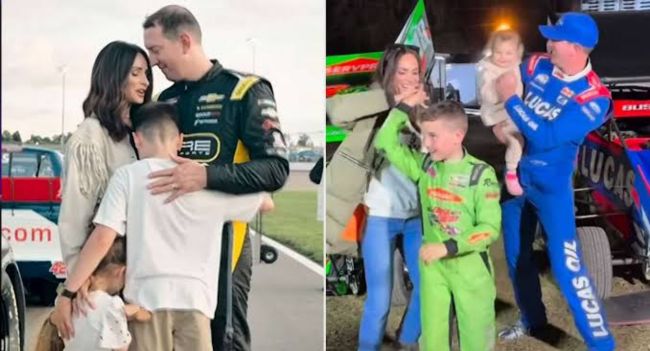
This year’s Father’s Day looked very different for Samantha Busch and her children as they faced the holiday without Kyle for the first time. While many expected an emotional tribute to the NASCAR star, it was a quiet family moment involving Brexton and Lennix that left fans especially heartbroken.

Samantha Busch is remembering her late husband, Kyle Busch, with an emotional Father’s Day tribute one month after his death.

The NASCAR champion died on May 21 at the age of 41 after a severe case of pneumonia progressed into sepsis, leaving behind his wife and their two children, 11-year-old Brexton and 4-year-old Lennix.

Sunday (June 21) marked the family’s first Father’s Day without him, and Samantha shared a heartbreaking message on social media about navigating a day that was supposed to be filled with celebration.

Samantha Busch Remembers Kyle on Father’s Day

In her post, Samantha reflected on the Father’s Day cards that had already been made and the painful reality that there was no longer anyone to give them to.

Read More: Kyle Busch’s Wife Samantha Made a Powerful Promise to Him Before He Died

“This still doesn’t feel real at all,” she wrote. “I was up all night thinking about what today should have looked like for Kyle and the kids. The Father’s Day cards that were already made, sitting in a drawer with no one to give them to.”

Read More: Kyle Busch’s 11-Year-Old Son Stunned NASCAR Fans: You’re Superman

She also reflected on the kind of father Kyle was to their children.

He was the dad who never missed a chance to be silly, race the kids around the neighborhood, wrap them in his arms, or stay up a little longer for one more book, one more question, one more moment.

“Nothing made him prouder than being Brexton and Lennix’s dad,” she added.

The Painful Day

Samantha acknowledged that revisiting old memories has been incredibly painful, but said those moments also remind her how fortunate their family was to have Kyle in their lives.

Watching these memories hurts more than I can explain, but they also remind me how lucky we were to have him,” she wrote. Later in the post, she described the depth of the family’s grief.

Kyle, the kids, and I miss you every second of every day. Our hearts ache for you, but it’s more than that. Your absence is something we physically feel. Our bodies hurt from missing you, from reaching for someone who isn’t there, from loving someone we can’t hold anymore.

Samantha also vowed to keep Kyle’s memory alive for their children, saying, “I will keep telling your stories, sharing your laughs, and making sure Brexton and Lennix always know just how deeply they were loved by their dad.”

Read More: Kyle Busch’s Son Brexton Races for First Time Since His Dad’s Death

She ended the tribute with a simple message: “Happy Father’s Day. We love you and miss you more than words can say.”

NASCAR Continues to Honor Kyle Busch

Samantha’s Father’s Day tribute came one day after an emotional moment in the NASCAR world.

Richard Childress Racing, the team Kyle drove for in the NASCAR Cup Series, returned to Victory Lane for the first time since his death when Austin Hill won the O’Reilly Auto Parts Series race at Naval Base Coronado in San Diego.

After the race, Hill revealed that he had been thinking about his late teammate during the closing laps. “I’m like, ‘Man, Kyle, if you’re watching this race, I could use some help here,’” Hill said.

He explained that a last-minute adjustment to the car seemed to change everything, saying, “And that exact lap that I asked about it, I just started cranking the front brake. … those last four laps, the car just came to life.”

After taking the checkered flag, Hill celebrated with a burnout next to a tribute painted on the track in Kyle’s honor.

One month after his death, tributes to Kyle continue to pour in from both his family and the racing community he left behind.

The History of NASCAR in 30 Stunning Photos

Ever since its inception in the late 1940s, the National Association for Stock Car Auto Racing — better known as NASCAR — has been full incredible moments, history-defining wins and heart-pounding photo finishes. Keep reading to look back at some of the powerful images that tell NASCAR’s story.

Gallery Credit: Carena Liptak

NASCARs Prohibition Era Roots

Topical Press Agency/Getty Images

NASCAR’s Prohibition Era Roots

During the U.S.’ Prohibition Era between January 1920 and December 1933, bootleggers developed a brisk trade illegally manufacturing and distributing alcohol to consumers who couldn’t buy it in a store. To do this, they modified ordinary-looking cars to drive faster than normal vehicles and carry as much liquor as possible.
These modified “runner” cars were also used for entertainment, beginning with informal community races. This laid the foundation for the stock car racing sport that would become NASCAR.
1932: Ford Introduces the Flathead V8

General Photographic Agency/Getty Images

1932: Ford Introduces the Flathead V8

Ford’s flathead V8 became a favorite choice for bootleggers after the model was introduced in 1932, due to the engine’s power and capacity for speed. They started using the car on liquor runs, and police officers followed suit in an attempt to keep up with the bootleggers, according to Prohibition.
Prohibition laws may have lifted in 1933, but stock car racing was just getting started (and the liquor-smuggling business continued as a workaround for taxes and regulations). A 1933 Ford V-8 Roadster was the winner of the first officially organized stock car race, the 1933 Elgin National Road Race, which was held in the Chicago area.
December 14, 1947: Bill France, Sr. Gets the Ball Rolling

ISC Archives/CQ-Roll Call Group via Getty Images

December 14, 1947: Bill France, Sr. Gets the Ball Rolling

Bill France, who moved from Washington, D.C. to Daytona, Fla. during the Great Depression, was already an avid stock car driver and enthusiast in the 1930s. He helped host multiple racing events across the ’30s and ’40s, and built the Occoneechee Speedway in 1947.
In December of that year, France organized talks at Daytona Beach’s Streamline Hotel with drivers, mechanics and car owners about organizing racing efforts. Those talks culminated with the formation of the National Association for Stock Car Auto Racing (NASCAR).
Feb. 15, 1948: Red Byron Wins the First-Ever NASCAR Race in Daytona Beach

ISC Images & Archives via Getty Images

Feb. 15, 1948: Red Byron Wins the First-Ever NASCAR Race in Daytona Beach

The first official sanctioned points NASCAR race took place on Feb 15, 1958, on the then-2.2 mile Daytona Beach-Road Course. A crowd of about 14,000 turned out to watch the race, paying $2.50 a pop. Driving a Ford, Red Byron claimed the large, silver Bundles for Britain trophy. He’d already won two beach races in Daytona in the previous two years leading up to NASCAR’s first race.
June 19, 1949: The First Strictly Stock Race Takes Place at Charlotte Fairgrounds Speedway

ISC Archives/CQ-Roll Call Group via Getty Images

June 19, 1949: The First Strictly Stock Race Takes Place at Charlotte Fairgrounds Speedway

The year 1949 brought the inaugural NASCAR Strictly Stock season (now known a the NASCAR Cup Series.) The very first race was held on June 19 at the Charlotte Fairgrounds Speedway, and Jim Roper was the winner. In October, Red Byron won the first Strictly Stock championship.
Feb. 22, 1959: The First-Ever Daytona 500

ISC Images and Archives via Getty Images

Feb. 22, 1959: The First-Ever Daytona 500

Held at the then-newly constructed Daytona International Speedway, the inaugural Daytona 500 took place on Feb. 22, 1959. A crowd of 41,921 turned out to watch the race. Lee Petty took home the win in a 1959 Oldsmobile.
He edged out Johnny Beauchamp in a photo finish, and in fact, Beauchamp was declared the winner in the moment. But with help from photos and video footage, NASCAR founder Bill France, Sr. declared Petty the victor three days later.
Dec. 1, 1963: Wendell Scott Becomes the First Black Driver to Win a Race in NASCARs Premiere Series

ISC Archives/CQ-Roll Call Group via Getty Images

Dec. 1, 1963: Wendell Scott Becomes the First Black Driver to Win a Race in NASCAR’s Premiere Series

Wendell Scott was the first Black driver and team owner to compete and win on NASCAR’s highest level. He had already won regional championships when he was issued a NASCAR license in the mid-1950s, and in 1963, he beat out Buck Baker to win a race at Speedway Park in Jacksonville, Fla. Scott would continue to be a top driver throughout the ’60s.
Jan. 10, 1972: Bill France, Sr. Passes the Torch to His Son

ISC Archives/CQ-Roll Call Group via Getty Images

Jan. 10, 1972: Bill France, Sr. Passes the Torch to His Son

Bill France, Sr. had been the president of NASCAR ever since he founded it, but on Jan. 10, 1972, he handed over the organization to his son, Bill France, Jr.
The younger France would make some major changes to the sport. According to Autoweek, it was his direction that led NASCAR toward more TV exposure and sponsorships, and he also reduced the racing schedule in order to put more publicity into the bigger events.
Feb. 20, 1977: Janet Guthrie is the First Female Driver to Race in the Daytona 500

National Motor Museum/Heritage Images via Getty Images

Feb. 20, 1977: Janet Guthrie is the First Female Driver to Race in the Daytona 500

Janet Guthrie began racing in the 1960s, and by the following decade, she was breaking barriers as the first woman to compete in a major NASCAR event. She became the first woman to compete in the Daytona 500 in 1977, finishing 12th and earning the honor of Top Rookie.
That same year, she became the first woman to compete in the Indy 500. Guthrie’s best career finish was 6th place at Bristol Motor Speedway in 1977, and she is now tied with Danica Patrick for best finish in a top-tier NASCAR race.
Feb. 18, 1979: CBS Televises the Daytona 500, Including a Brawl!

ISC Archives/CQ-Roll Call Group via Getty Images

Feb. 18, 1979: CBS Televises the Daytona 500, Including a Brawl!

The Daytona 500 aired on CBS in live, flag-to-flag coverage in 1979, which was a first for a 500-mile race in the U.S. It was a particularly exciting race.
Cale Yarborough and Donnie Allison led in the final lap, but collided and wrecked in the grass before they made it to the finish line. That paved the way for Richard Petty to claim his sixth Daytona 500 victory — and it also led to some unexpected excitement when Yarborough, Allison and Allison’s fellow racer brother Bobby became embroiled in a fight on live TV.
July 4, 1984: Richard Petty Sets a Record That Still Stands Today

Jim Gund/Allsport/Getty Images

July 4, 1984: Richard Petty Sets a Record That Still Stands Today

Richard Petty put a new notch in his NASCAR superstardom on July 4, 1984, when he won his 200th race at the Firecracker 400 at Daytona National Speedway. That extended his longstanding record, which has yet to be broken today.
Other notable events from the race included an appearance from then-sitting U.S. president, Ronald Reagan, and the fact that this was the last win of Petty’s NASCAR career. Petty would go on to be inducted into the NASCAR Hall of Fame in 2010, as part of the Hall’s inaugural class.
Apr. 30, 1987: Bill Elliott Sets a Record For Speed

by ISC Archives/CQ-Roll Call Group via Getty Images

Apr. 30, 1987: Bill Elliott Sets a Record For Speed

Bill Elliott made NASCAR history on April 30, 1987, when he set a record for the fastest lap ever at 212.809 mph. The moment took place at Talladega Superspeedway in Talladega, Ala.
The following season, cars would be modified with smaller carburetors, which limited horsepower.
June 7, 1992: Bill France, Sr. Dies

Robert Alexander/Getty Images

June 7, 1992: Bill France, Sr. Dies

Bill France, Sr., aka “Big Bill,” died on June 7, 1992, at the age of 82. His cause of death was Alzheimer’s disease. He was remembered as the founder of NASCAR as well as the organization’s former president, and would go on to be inducted as part of the first class of NASCAR Hall of Fame honorees.