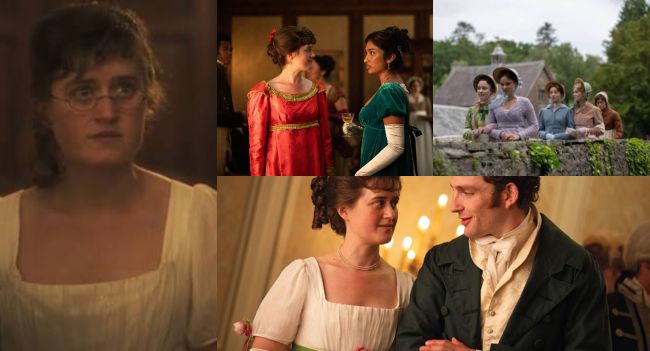
Have we misjudged Mary Bennet? Why her story should resonate deeply with Christian women
With sternly parted hair, a pedantic and holier-than-thou air, and a plain wardrobe, Mary Bennet was most certainly not the literary heroine of my childhood dreams. Over the decades, previous television and film adaptations of Pride and Prejudice have consistently pushed her into the margins, painting her as a caricature of awkwardness—the sister who sings poorly at balls and offers rigid, unsolicited moral platitudes while her more “presentable” and glamorous sisters capture every eye in the room.

But the reality is that most of us are Marys. We are not all model-worthy material, we aren’t all destined to marry wealthy aristocrats, and very few of us are naturally gifted with the ability to respond with flawless, quick-witted remarks in every social conversation. For generations, women—especially within faith communities—have been subtly conditioned to seek validation through external markers: physical beauty, a charming social presence, or the immediate security of marriage. When we don’t fit into those neatly constructed boxes, a quiet sense of loneliness and inadequacy often takes root.
This is precisely why the protagonist of the new BBC series The Other Bennet Sister (streaming on BritBox) is so heart-warming, liberating, and surprisingly modern in its take-home message. Based on Janice Hadlow’s novel, the series forces us to ask: Have we profoundly misjudged Mary Bennet?
The Danger of the “Wallflower” Label
In a world that constantly demands women to be loud, beautiful, and hyper-social, quiet and thoughtful women are almost always overlooked. In the series, we see a Mary (played with exquisite nuance by Ella Bruccoleri) who has spent her entire life on the sidelines, surviving under the constant, shrill criticisms of her mother, Mrs. Bennet, who openly disparages Mary’s looks and her deep love for books.
There is a growing opinion among critics and viewers alike that Mary’s early defensive behavior—her tendency to sound “holier-than-thou”—was never a character flaw, but rather a survival mechanism. When a young woman is told she is not beautiful enough or charming enough for the world, she will naturally seek refuge in intellect and moral rigidity. She creates a fortress out of her books.
However, The Other Bennet Sister beautifully charts her journey of breaking free from her family’s suffocating expectations to embark on a path of self-discovery. When Mary finally leaves the familiar halls of Longbourn to live in the bustling city of London, she begins to find her true footing. She discovers that her value does not diminish simply because she doesn’t command the attention of a room full of suitors.
A Resonance with Faith and Contentment
For Christian women, Mary’s evolution speaks directly to the soul. It reminds us that God’s design for contentment has absolutely nothing to do with conforming to cultural standards of social success or physical perfection. Instead, true peace comes from completely embracing exactly who He made us to be.
Mary’s journey teaches us that our “eclectic curiosities,” our love for quiet reflection, and our intellectual pursuits are not defects to be cured—they are gifts to be utilized. True autonomy and confidence begin not when we successfully mimic the charms of others, but when we quiet the disapproving voices of our past and align ourselves with our true identity. As Coco Chanel once famously said, “Beauty begins when we decide to be ourselves,” and as the modern landscape is slowly realizing, “clever is the new cool.”
There is immense hope for book-loving, typically overlooked women who have felt left behind by the fast-paced, appearance-driven structures of society. Mary Bennet’s story is a gentle but powerful reminder that you do not need to be the glittering heroine of a traditional romance to live a life of profound purpose, courage, and joy. It starts by simply having the bravery to be yourself.
Source: https://www.womanalive.co.uk/opinion/have-we-misjudged-mary-bennet-why-her-story-should-resonate-deeply-with-christian-women/21311.article